











In 552, two Nestorian monks on a mission from Emperor Justinian I smuggled silkworm eggs hidden inside hollow bamboo canes from Sogdia, a region in what is now eastern Uzbekistan, to Constantinople, the capital of the Byzantine Empire. Before Justinian's heist, the silk trade to Europe was controlled in the East, first by China, where silk cultivation began, and then by a succession of Persian empires culminating in the Sassanid Empire of Justinian's time.
Justinian established silk cultivation to prevent the Persians from cutting off the supply of silk in times of war. Once established, silk production led to a profitable imperial monopoly on the production and sale of silk within the Empire and to the rest of Europe: "After Justinian I, the manufacturing and sale of silk had become a state monopoly." Angeliki E. Laiou, Exchange and Trade, Seventh–Twelfth Centuries, in The Economic History of Byzantium (2002). The emperor best known for the Code of Justinian, the codification of Roman law that underlies the civil law systems of continental Europe, was also the founder of European silk cultivation.
It was not until 1147, 600 years later, that the Byzantine monopoly on silk would be broken. Norman king Roger II of Sicily sacked the imperial cities of Corinth and Thebes, kidnapping Greek silk weavers and installing them at Palermo, on Sicily. The twelfth-century German chronicler Otto of Freising recorded the deportation; the captured weavers became the foundation of the Sicilian silk industry. By the thirteenth century, Lucca, on the Italian mainland, had overtaken Palermo as Italy's dominant silk center, pulling in Sicilian, Jewish, and Greek weavers, and specializing in drappi auroserici — silks threaded with gold and silver. When the Fourth Crusade resulted in the sack of Constantinople and the fragmentation of the Byzantine Empire in 1204, leadership in European silk-weaving passed west for good. Venice, Lucca, and Florence — by 1472 Florence alone had 84 workshops and at least 7,000 craftsmen — all pulled the industry further into the Italian peninsula.
In the fourteenth century, the Visconti family, dukes of Milan, began encouraging mulberry cultivation and silkworm breeding in the hills around Lake Como. By the fifteenth century, Bianca Maria Visconti, the last Visconti heir, married Francesco Sforza, establishing the House of Sforza as dukes of Milan. His son Ludovico Sforza became duke in 1494 and greatly expanded the silk industry around Como, so much so that he earned the nickname Il Moro from the Lombard moro, the mulberry tree whose leaves silkworms eat before spinning mulberry silk. By some accounts, tens of thousands of workers were employed in the duchy's silk industry during Ludovico's reign.

In the fifteenth century, art and silk were already partners. In 1498, the duke commissioned a 46-year-old Leonardo da Vinci to paint the ceiling of the Sala delle Asse at Castello Sforzesco. Leonardo painted a trompe-l'œil pergola of eighteen mulberry trees — a clear reference "to [the Duke's] nickname of il Moro." In Leonardo's ceiling, the branches of the mulberry trees are bound together in a canopy by golden ropes, woven into elegant knots. We echo the rope-and-knot motif on the paper that wraps new Moutonière silk art scarves.
By the mid-eighteenth century, spinning and weaving mills had spread across Como, powered by the Cosia stream that still runs past the Museo della Seta today. In 1866, after Italian Unification, Como entrepreneurs opened a silk-works at the local Technical Institute. In 1869 they founded the Setificio Paolo Carcano, a school that, according to one profile, "trained the most talented of Italy's silk masters and still does today." In 1945, a twenty-nine-year-old born in Como opened the Tessitura Serica Antonio Ratti — a house whose archive now holds over 400,000 fabric samples, and whose foundation keeps 3,300 textile fragments spanning the third to the twentieth century. Ratti called textiles "a cultural product." In 1995, he endowed the Antonio Ratti Textile Center at the Metropolitan Museum of Art in New York. Today, Como produces roughly 3,200 tonnes of silk a year — most of Italy's silk, and the majority of Europe's. The secret smuggled out of China in a hollow cane in 552 is now centered on one Italian lake town.
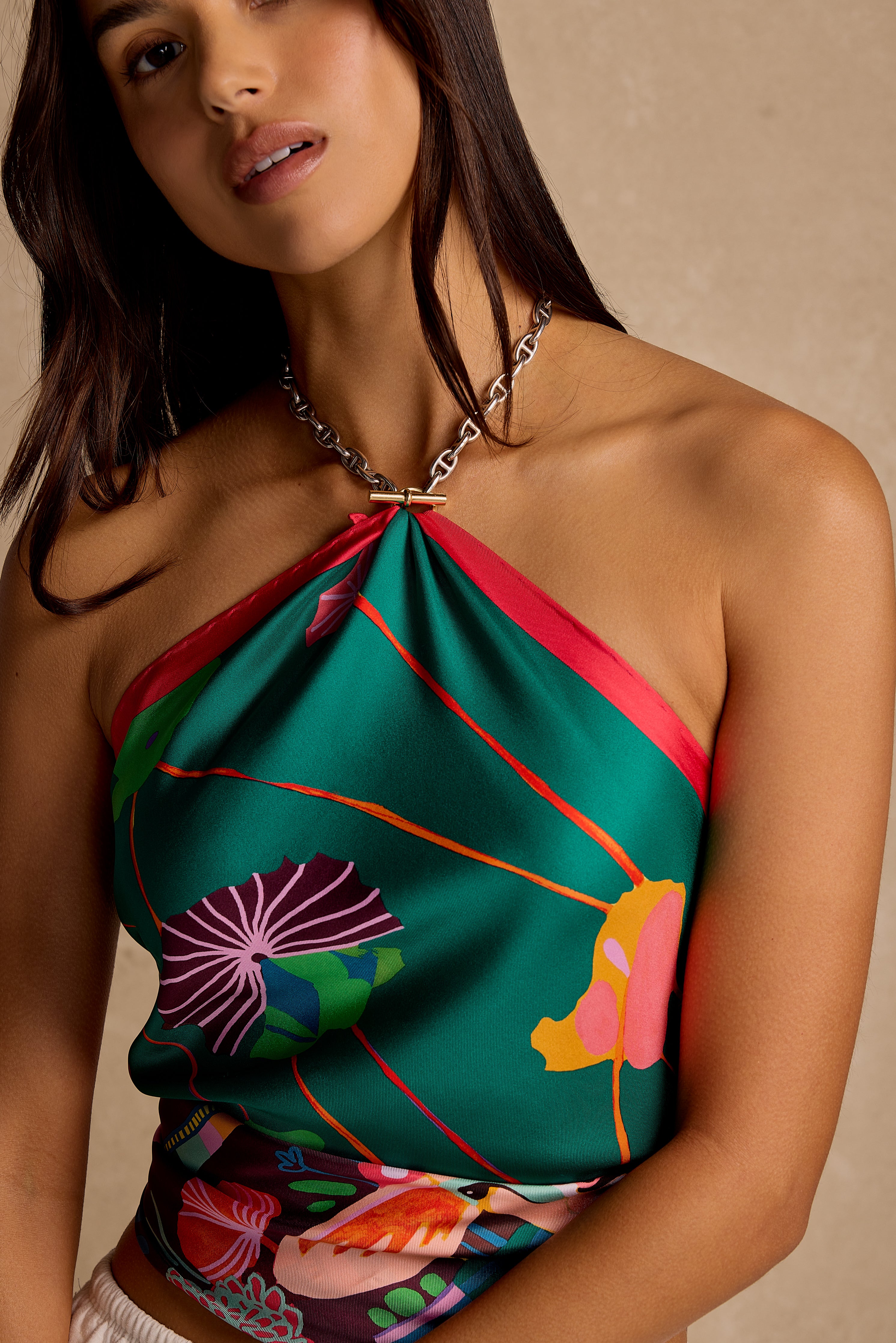
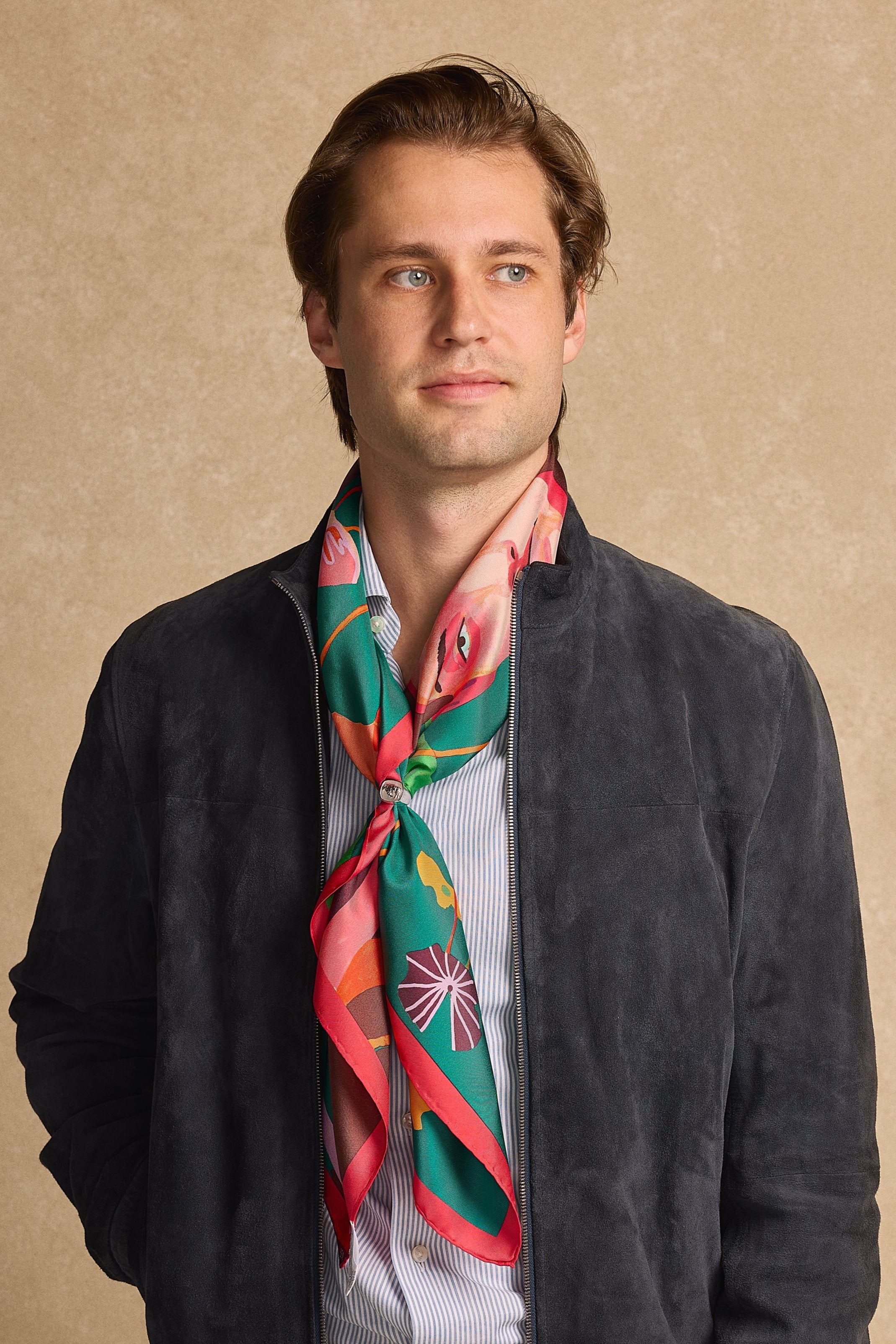
We chose to make our silk art scarves in Como to connect to this heritage, which runs from Byzantine monks to a duke's orchards to Leonardo's ropes winding between mulberry trees. And we choose to produce our scarves the old way, with hand-engraved screens, one screen per color, and hand-rolled edges, each scarf bringing to life in silk original paintings commissioned from some of our favorite mid-career contemporary artists. You can read more in Artisan Details: Silk Art Scarves and Art of F/W 2024 and dive into artist video interviews for Andy Dixon, C.M. Duffy, Filipp Jenikäe, and Patrick Puckett. Each scarf is numbered, signed, and issued with a certificate of authenticity, in editions small enough to count by hand.
From bamboo cane to mulberry orchard, from Byzantine loom to Palermo workshop, from Lucca's gold-threaded drapes to Ludovico's moro, from Leonardo's painted knots to a long screening table by a lake — the thread of silk's story has been, for fifteen hundred years, in somebody's hands. And when you slip on a Moutonière silk art scarf, that thread is in your hands.